The
Thomas A. Dorsey
Legacy
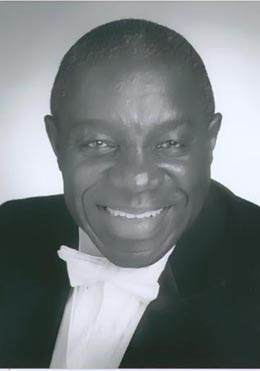 by
ORAL MOSES
Precious Lord, take my hand, lead me on, let
me stand, I am tired, I am weak, I am worn; Thru the storm, thru the night,
lead me on to the light, take my hand precious Lord, lead me home.
These very poignant, powerful and pleading words
came to Thomas Andrew Dorsey during his period of mourning after the loss
of his beloved wife, Nettie, and their newborn baby.
Thomas A. Dorsey, Georgia Tom, as he was called
while serving as pianist for the great blues singer, Gertrude ma Rainey,
had heard the voice of God tell him to, come out of the blues, and changed
his way of living. In making this change in his life Dorsey had heard many
of the religious songs composed by Charles Albert Tindley and decided to
try and compose songs in a similar style.
Charles Albert Tindley (1856-1933) was born a
slave in Berlin, Maryland. As child he had taught himself to read and became
known as, boy with the bare feet who could read. He was called into the
ministry and after several years of struggling he was made pastor of the
very church in which he had earlier served as its sexton. when he started
writing songs is not known however during his life, Tindley wrote such
songs as, Stand By Me, Nothing Between, Well Understand It Better
By and By, Let Jesus Fix It for You, and Bread of Heaven. Other musicians
like Lucie Eddie Campbell Williams (1885-1963) followed Tindleys style
with songs like ,Something Within Me, and Hell Understand And Say, Well
Done and William Herbert Brewster (b. 1899) composed, Move on Up A Little
Higher, and Surely, God Is Able. However only Dorsey seem to have captured
the true essence of Tindleys formula which ,concentrated on texts that
gave attention to concerns of black Christians as worldly sorrows, blessings,
and woes, as well as the joys of the after-life. He also made great use
of the pentatonic scale and allowed use of the so-called blue thirds and
sevenths. And finally Tindley allowed for improvisation of the text, melody,
harmony and rhythm which is a major characteristic feature in the music
of black-American folk and popular music.
By 1926 Dorsey had made some progress. His first
success, If You See My Savior, had been published and he began to make
every effort to see that his success was heard around Chicago. However
he had no idea of the opposition he would face from the pastors and church
choir directors alike. They felt these songs had too much vigor and they
did not want their congregation to be rocked and swayed. The major complaint
from the ministers
was that these songs were in strong competition
with their sermons. Despite this opposition the ,Dorsey Sound, spread
rapidly among small church congregations. It was during these early days
that he met Sallie Martin and after some convincing, from her, agreed to
teach her some of his songs. The results was a Thomas Dorsey/Sallie Martin
union. As this union grew Dorsey met other young singers who were also
eager to sing these early new songs. Many of those people were, Mahalia
Jackson, Willie Mae Forde Smith, Clara Ward and Roberta Martin (no relations
to Sallie Martin).
As Dorsey worked relentlessly to spread this new
bluesy music around, an 19 year old young lady with flattering facility
on the guitar was hired to perform with Cab Calloway at the famous Cotton
Club in Harlem, New York. Rosetta Tharp, was convinced in her faith and
so effectively convinced other people that she was able to sing in both
the Cotton Club and Churches as well. In 1939, despite her patronage with
the cotton club, Rosetta Tharp rocked the Cotton Club with her song, God
Dont like it.
I know you dont like my song
I just made it up in my mind
I wont take back not a word I said
cause I sure dont drink moonshine
God dont like it I know he dont like it
I know, aint you glad he dont like it
I know its a scandalous and a shame.
In yet another effort to solidify his sound and
style, Dorsey, in 1932 along with Sallie Martin organized the first Black
Gospel Music Convention - The National Convention of Gospel Choirs and
Choruses. This effort brought Gospel singers and choirs together from all
parts of the United States. In this effort Dorsey spoke in defense of this
bluesy musical style in his opening address. He stated emphatically ,the
message is not in the music but in the words of the song. It matters not
what kind of music or what kind of movement it has, if the words are Jesus,
Heaven, Faith, and life then you have a song with which God is pleased
regardless to what critics and some church folk say.
In the years that followed this, Dorsey sound,
has been carefully nurtured by the likes of Roberta Martin, creating her
own unique style then passing her skill and insight on to her pupil, James
Cleveland. The Rev. Cleveland brought to this the power of his unique raspy
sound painting us vivid pictures of Jesus calmly saying, Peace Be Still,
By the 60s Gospel was well on its way to being an established form of
religious music in America. During these very turbulent days of struggle
a young man out of Oakland added to gospel a new popular sound that rocked
America in the midst of all of the civil unrest. Edwin Hawkins borrowed
an old church hymn and created a whole new sound in gospel with his Gospel
arrangement, O Happy Day.
Since the appearance of Edwin Hawkins on the Gospel
scene, this music has rapidly spread throughout the world of music. In
this modern era Gospel music has become an economic success that rivals
jazz, blues, rock, R&B and even the classics. Much of the credit for
this goes to, like Dorsey in his youth, the younger generation. Many of
those to be mentioned are Andre Crouch, Twinkie Clark, Richard Smallwood,
The Winans, Donald Vails, and the latest and most recent Gospel sensations,
Kirk Franklin and Lamar Campbell. Even before these young Gospel Music
icons a group of six young men calling themselves, Take 6, introduced strong
Jazz idoms into traditional gospel songs that created yet another new sound
in Gospel. All of these young Gospel artists have continued the Tindley/Dorsey
legacy. They continue to keep us on the cutting edge of new sounds by clouding
and distorting the lines of, good respectable church Music.
|